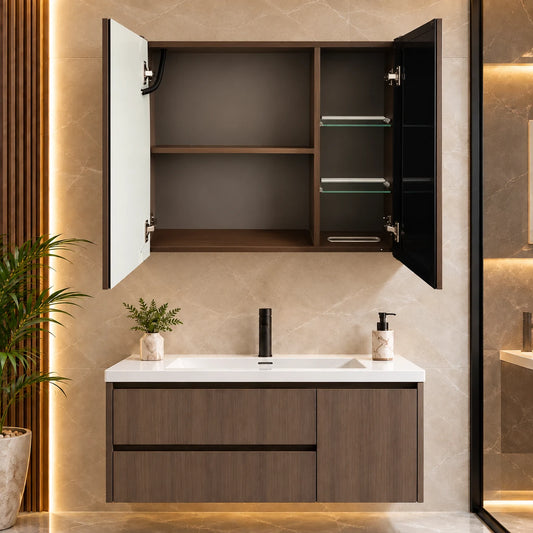
Collection: Bathroom Vanity
A bathroom vanity puts the basin, the storage and the mirror into one unit, which is why it has largely replaced the pedestal basin in new Indian bathrooms. The range here is built on four body materials - waterproof PVC, aluminium with PVC, stainless steel and HDHMR - with basin tops in sintered marble or moulded counter. Widths run from a compact 450 mm and 500 mm through the common 600 mm and 800 mm up to a 1000 mm and a double-width 1200 mm. Almost every unit ships with a mirror: plain, LED backlit, three-colour LED, anti-fog, sensor-operated or a full mirror cabinet with storage behind. Colours include white, black, grey, ivory, apricot and green. Prices run from around ₹7,700 for a 500 mm PVC unit to about ₹36,000 for a 1200 mm double vanity with a sintered marble basin and LED mirror.
How to choose a bathroom vanity
- Width, then depth. Measure the clear wall and check the door swing. A 500 mm unit is the realistic maximum in many Indian bathrooms; 600 mm is the standard; 800 mm and above need a dedicated wall. Deep cabinets of around 490 to 500 mm hold more but eat floor space.
- Tap hole or no tap hole. Some tops are supplied drilled for a deck-mounted mixer and some are not, because they are meant for a wall-mounted tap. Decide this before ordering - it cannot be changed sensibly afterwards.
- Body material against your bathroom. PVC and aluminium bodies do not swell or rust, which is the failure mode of ordinary plywood vanities in a wet Indian bathroom. HDHMR is a denser engineered board treated for water. Stainless steel is the most robust of the lot.
- Sintered marble or moulded top. Sintered marble is dense, resists staining and gives a stone look without natural stone's porosity. A moulded counter costs less and is lighter to mount.
- Mirror function. An LED mirror needs a power point behind it, so plan the electrical point at the same time. Anti-fog is genuinely useful in a closed bathroom with a geyser; a mirror cabinet buys storage a plain mirror does not.
Wall mounting and humidity
Most of these vanities are wall hung, which keeps the floor clear for cleaning and avoids the damp that collects under a floor-standing cabinet. That puts the whole load on the wall, so a solid masonry wall or properly backed partition is essential. Leave the plumbing accessible: the waste and the angle valve sit inside the cabinet, so a unit with a cut-out or removable back panel is easier to live with. In coastal and monsoon-humid homes, the hinges and rails matter as much as the carcass - keep the cabinet ventilated and wipe spills off the counter rather than letting water sit at the joint between basin and top.
Common questions
What size vanity fits a small bathroom? A 450 mm or 500 mm unit. Below that you are better off with a pedestal basin, because the cabinet stops being usable storage.
Do I need a separate basin and tap? The basin comes with the vanity. The tap does not, so order a mixer to suit - deck-mounted if the top is drilled, wall-mounted if it is not.
Will a PVC vanity last in a wet bathroom? PVC does not absorb water or swell, which is exactly why it is used here in place of plywood. The parts to watch are the hinges and the wall fixings, not the panels.

-
Matt White Sintered Marble Vanity with 3-Colour LED Mirror – 60 & 80 cm | JBV01046
Regular price From Rs. 16,500.00Regular price From Rs. 16,500.00 Sale priceUnit price perRs. 22,000.0025% -


Sintered Marble Bathroom Vanity with 3-Colour LED Mirror – White or Black, 3 Sizes | JBV01041A
Regular price From Rs. 9,900.00Regular price From Rs. 9,900.00 Sale priceUnit price perRs. 10,400.004% -
500mm Grey PVC Vanity with Large Square Mirror – Waterproof, Compact | JBV01048
Regular price Rs. 8,419.00Regular price Rs. 8,419.00 Sale priceUnit price perRs. 15,000.0043% -
Sintered Marble Bathroom Vanity with LED Mirror – White or Black, 60 & 80 cm | JBV01001C
Regular price From Rs. 12,499.00Regular price From Rs. 12,499.00 Sale priceUnit price perRs. 13,499.007% -
500mm Compact PVC Bathroom Vanity with Mirror – Metallic Grey, Waterproof | JBV01025
Regular price Rs. 7,725.00Regular price Rs. 7,725.00 Sale priceUnit price perRs. 10,300.0025% -
1200mm Double-Width Grey Vanity with Sintered Marble Basin & LED Mirror | JBV01004B
Regular price Rs. 36,110.00Regular price Rs. 36,110.00 Sale priceUnit price perRs. 48,150.0025% -
White PVC Bathroom Vanity with Mirror – Waterproof, 60 & 80 cm | JBV01043
Regular price From Rs. 18,750.00Regular price From Rs. 18,750.00 Sale priceUnit price perRs. 25,000.0025% -
500mm Compact Grey PVC Vanity with Tall 720mm Mirror – Waterproof | JBV01040
Regular price Rs. 12,000.00Regular price Rs. 12,000.00 Sale priceUnit price perRs. 16,000.0025% -
Stainless Steel Bathroom Vanity with Mirror Cabinet – Light Apricot, 60 & 80 cm | JBV01037
Regular price From Rs. 18,750.00Regular price From Rs. 18,750.00 Sale priceUnit price perRs. 25,000.0025% -

Sintered Marble Bathroom Vanity with 3-Colour LED Mirror – 60 & 80 cm, White or Black | JBV01042A
Regular price From Rs. 14,000.00Regular price From Rs. 14,000.00 Sale priceUnit price perRs. 15,000.006% -
Ivory PVC Bathroom Vanity with Mirror – Waterproof, 60 & 80 cm | JBV01045
Regular price From Rs. 16,875.00Regular price From Rs. 16,875.00 Sale priceUnit price perRs. 22,500.0025% -
Grey Aluminium PVC Bathroom Vanity with LED Mirror – Rust Proof, 60 & 80 cm | JBV01032A
Regular price From Rs. 13,799.00Regular price From Rs. 13,799.00 Sale priceUnit price perRs. 14,299.00Sold out -
Bathroom Vanity 800x475x440mm- JBVN02005
Regular price Rs. 26,250.00Regular price Rs. 26,250.00 Sale priceUnit price perRs. 35,000.0025% -
White PVC Bathroom Vanity with Mirror – Slim 150mm Counter, 60 & 80 cm | JBV01044
Regular price From Rs. 26,625.00Regular price From Rs. 26,625.00 Sale priceUnit price perRs. 35,500.0025% -
600mm Grey Aluminium PVC Vanity with Mirror Cabinet – Rust Proof | JBV01039
Regular price Rs. 13,875.00Regular price Rs. 13,875.00 Sale priceUnit price perRs. 18,500.0025% -
800mm Deep Bathroom Vanity with LED Mirror Cabinet – White, 500mm Depth | JBV01014A
Regular price Rs. 20,400.00Regular price Rs. 20,400.00 Sale priceUnit price perRs. 27,200.00Sold out -
Ceramic Pop-Up Waste Coupling for Wash Basin – 3 inch & 5 inch | WC01004
Regular price Rs. 750.00Regular price Rs. 750.00 Sale priceUnit price perRs. 1,000.0025% -
Compact Black Sintered Marble Vanity with LED Mirror – No Tap Hole, 450mm | JBV01047A
Regular price Rs. 12,750.00Regular price Rs. 12,750.00 Sale priceUnit price perRs. 17,000.0025% -
Grey PVC Bathroom Vanity with Square Mirror – Waterproof, 60 & 80 cm | JBV01027
Regular price From Rs. 13,125.00Regular price From Rs. 13,125.00 Sale priceUnit price perRs. 17,500.0025% -

800mm Sintered Marble Vanity with Anti-Fog 3-Colour LED Mirror – White or Black | JBV01002A
Regular price Rs. 23,400.00Regular price Rs. 23,400.00 Sale priceUnit price perRs. 31,200.0025%