Collection: Flushing System
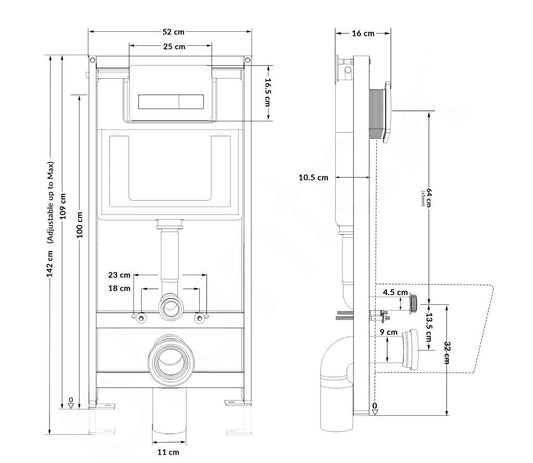
A flushing system is everything behind and above the WC that delivers the flush: the cistern that holds the water, the flush mechanism inside it, and the button or plate you press. This range covers three approaches. Exposed ABS flush tanks in white, single flush and dual flush, at 6 litres and push-button operated, sit at the affordable end from around ₹800. Concealed cisterns in white HDPE at 9 litres, supplied either bare or with a full frame stand, run up to around ₹9,800. Flush plates for those concealed cisterns come in square and round profiles, dual flush, in glossy chrome, matt black and glossy rose gold. A one-piece toilet flush fitting kit in white ABS covers replacement of the internals in a one-piece WC.
How to choose a flushing system
- Start with the WC you already have or have chosen. A one-piece WC takes an internal fitting kit. A two-piece or wall-hung WC takes either an exposed tank or a concealed cistern. This decision is made by the pan, not by preference.
- Exposed or concealed. An exposed ABS tank is cheap, serviceable in five minutes and needs no wall work. A concealed cistern disappears into the wall and gives a clean line, but it must be planned before tiling and it needs the wall opened if the internals ever fail.
- Frame or no frame. A concealed cistern supplied with a full frame stand carries the load of a wall-hung pan itself, so it can go against a stud or light partition wall. A bare concealed cistern needs solid masonry behind it to take that weight.
- Single flush or dual flush. Dual flush gives a full and a reduced flush from the same tank and is the sensible default where water is metered or supply is intermittent. Single flush is simpler and has fewer parts to go wrong.
- Plate finish last. The flush plate is the only visible part of a concealed system, so it should match the taps and the waste coupling. Square plates suit bathrooms detailed in straight lines, round plates suit curved sanitaryware.
Hard water and what it does to a cistern
In most Indian cities the thing that eventually kills a flushing system is not the button but scale. Mineral deposits build on the inlet valve seat and the flush washer, and the first symptom is usually a cistern that keeps running quietly after flushing, or one that takes far longer than it should to refill. Neither means the tank is finished; both usually mean the inlet or outlet valve needs cleaning or replacing.
That is a strong argument for thinking about serviceability before you choose. An exposed tank can be opened by lifting the lid. A concealed cistern is serviced through the flush plate aperture, which is why the plate is designed to come off. Before committing to a concealed system, check that the aperture will remain reachable once the wall and the pan are finished.
Common questions
What is the difference between a flush tank and a concealed cistern? A flush tank sits visibly on or above the pan and is opened from the top. A concealed cistern is built into the wall behind tiling and is reached only through the flush plate. The water-holding job is the same; the difference is appearance, wall work and how you service it.
Do I need the frame stand version of a concealed cistern? You need it if the pan is wall hung and the wall is not solid masonry, because the frame rather than the wall carries the weight of the pan and the person using it. If the cistern sits in a solid brick or concrete wall behind a floor-mounted pan, the bare cistern is enough.
Can I change just the flush plate? Usually yes, provided the new plate matches the cistern and the actuator behind it. Changing the plate is the normal way to update the look of a bathroom without touching the wall, so check compatibility with your existing concealed cistern before ordering.

-
Single Flush Tank Cistern 6 Litre Push Type – White ABS | JFT01002
Regular price Rs. 800.00Regular price Rs. 800.00 Sale priceUnit price perRs. 1,000.0020% -
Square Flush Plate for Concealed Cistern – Dual Flush, Glossy Rose Gold | JFP01005
Regular price Rs. 6,000.00Regular price Rs. 6,000.00 Sale priceUnit price per -
Square Flush Plate for Concealed Cistern – Dual Flush, Glossy Chrome | JFP01001
Regular price Rs. 2,000.00Regular price Rs. 2,000.00 Sale priceUnit price per -
Concealed Cistern 9 Litre Dual Flush without Stand – White HDPE | JFT01005
Regular price Rs. 6,000.00Regular price Rs. 6,000.00 Sale priceUnit price per -
Concealed Cistern 9 Litre with Full Frame Stand – White HDPE | JFT01004
Regular price Rs. 9,800.00Regular price Rs. 9,800.00 Sale priceUnit price per -
One Piece Toilet Flush Fitting Kit – Push Type, White ABS | JFT01003
Regular price Rs. 2,000.00Regular price Rs. 2,000.00 Sale priceUnit price per -
Dual Flush Tank Cistern 6 Litre Push Type – White ABS | JFT01001
Regular price Rs. 1,440.00Regular price Rs. 1,440.00 Sale priceUnit price perRs. 1,800.0020% -
Round Flush Plate for Concealed Cistern – Dual Flush, Matt Black | JFP01003
Regular price Rs. 3,500.00Regular price Rs. 3,500.00 Sale priceUnit price per -
Round Flush Plate for Concealed Cistern – Dual Flush, Glossy Chrome | JFP01002
Regular price Rs. 2,000.00Regular price Rs. 2,000.00 Sale priceUnit price per