Collection: Intelligent Toilets
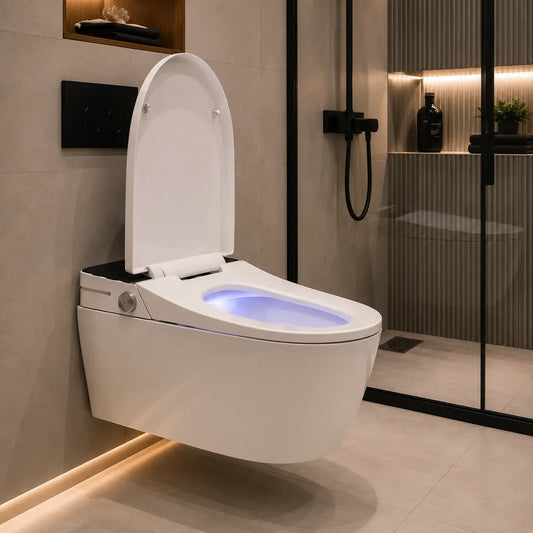
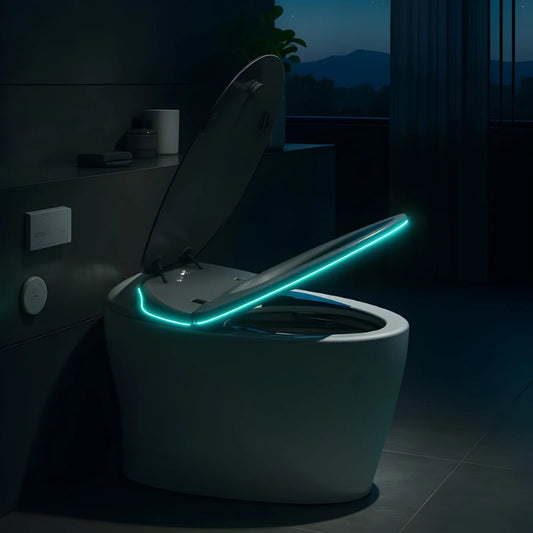
An intelligent toilet, also sold as a smart toilet, replaces the pan, the seat and the flush plate with one powered ceramic unit. Instead of a lever or a button you get a bidet wash, a soft close seat and touch-free flushing, and depending on the model a heated seat, UV sterilisation, a foot sensor flush or an LED display on the body itself. The range here is glossy white ceramic with a smooth glazed surface throughout, in both floor mounted S trap and wall hung P trap configurations. Prices run from around Rs 40,000 to Rs 60,000.
How to choose an intelligent toilet
- Start with the trap, not the features. An S trap pan sends waste vertically into the floor and drops onto the rough-in most Indian bathrooms already have. A P trap discharges horizontally into the wall. Getting this wrong means re-plumbing.
- Measure the trap distance. For an S trap, measure from the finished wall to the centre of the existing floor outlet and confirm it with us before ordering. This is the commonest cause of a returned smart toilet.
- Check for an earthed power point. Every unit in this range needs mains power near the toilet, and on a renovation that socket has to be planned in.
- Floor mounted or wall hung. A floor mounted pan carries its own weight and needs no concealed frame. A wall hung pan needs a frame and carrier built into the wall, decided before tiling.
- Pick the wash function you will use. A rear wash, a separately aimed female wash, a heated seat or UV sterilisation are the real differences between models at different prices.
What to plan for before installation
A smart toilet is as much an electrical job as a plumbing one. The power point should be earthed, within reach of the cable, and out of direct shower spray. Indian bathroom humidity is high year round and worse through the monsoon, so ventilation around the unit matters. Water quality matters too: the wash nozzle is a fine outlet and hard water will scale it, so a supply that scales heavily benefits from an inline filter. Clean the ceramic with a mild cleaner rather than a harsh acid.
Common questions
Does a smart toilet need electricity? Yes. Every unit in this range needs an earthed mains point near the installation for the wash, the seat and the sensors. It is not an optional extra.
What is the difference between S trap and P trap? An S trap discharges vertically into the floor, the usual Indian rough-in. A P trap discharges horizontally into the wall, common with wall hung pans. Match the pan to the waste you already have.
Will it work during a power cut? The wash, heated seat and sensor functions rely on power. Check the manual flush provision on the model you choose if power cuts are frequent where you live.

-
Smart Floor Mount Toilet S Trap with Female Wash Function – Glossy White | JST01003
Regular price Rs. 55,000.00Regular price Rs. 55,000.00 Sale priceUnit price perRs. 90,000.0038% -


Smart Floor Mount Toilet S Trap with LED Display & Foot Sensor Flush – Glossy White | JST01001
Regular price Rs. 40,000.00Regular price Rs. 40,000.00 Sale priceUnit price perRs. 60,000.0033% -
Smart Wall Hung Toilet P Trap with Soft Close Seat – White | JST01004
Regular price Rs. 60,000.00Regular price Rs. 60,000.00 Sale priceUnit price perRs. 110,000.0045% -
Smart Toilet with Heated Seat, UV Sterilisation & Foot Sensor – Floor Mount White | SATURN
Regular price Rs. 43,000.00Regular price Rs. 43,000.00 Sale priceUnit price perRs. 61,499.0030%